Ayaan Jindal
August 10, 2026 · 3 min read
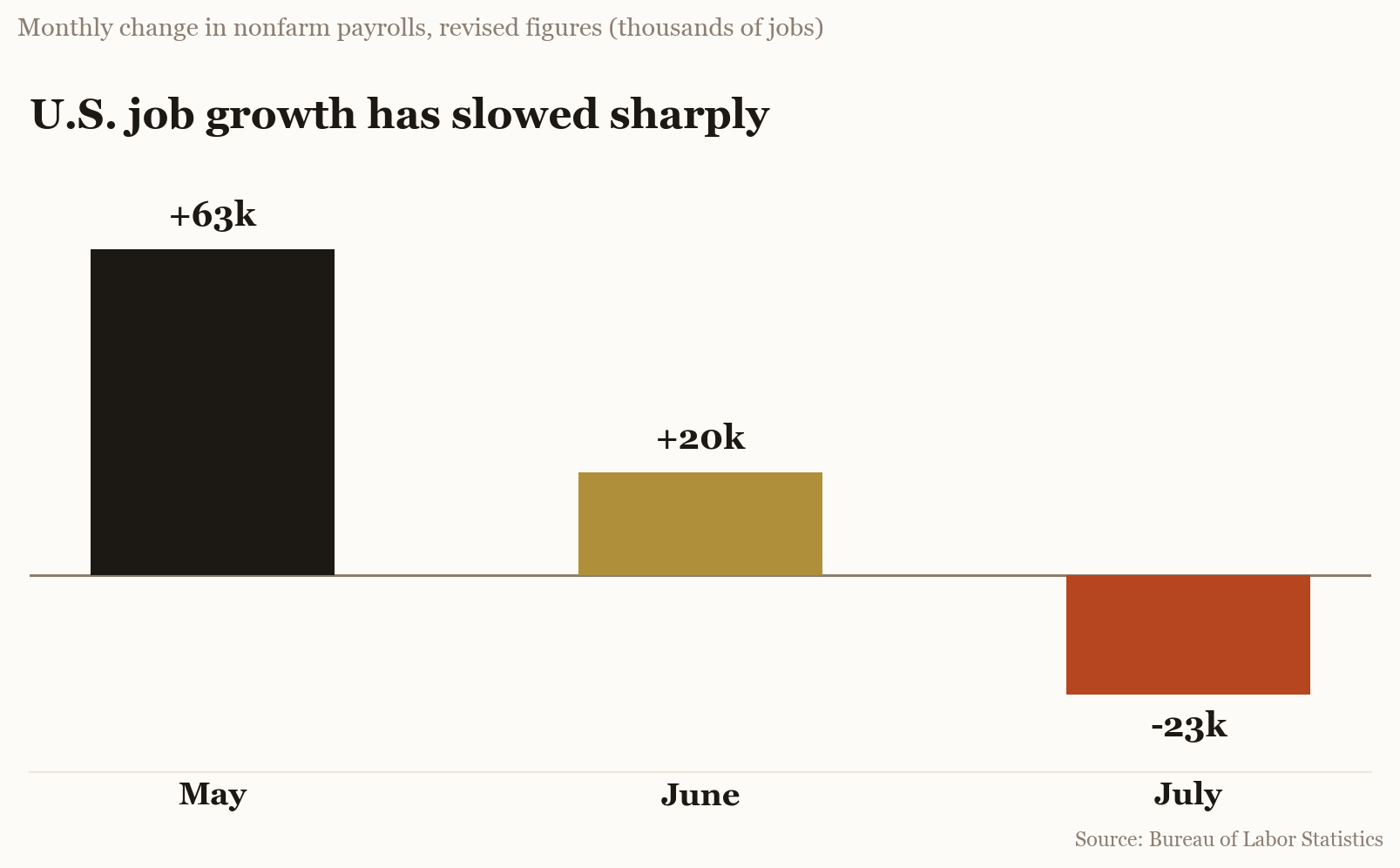
Every month the government reports how many jobs the economy has added or lost. Most of the time the change is a very small number either above or below zero. This past month was different though. On August 7 the economy reported that it had lost 23,000 jobs in July. This was the first time since February that payrolls had actually gone down instead of up and it missed expectations by a wide margin. Economists on average had predicted that the economy would add 85,000 jobs in July.
Where the Jobs Went
The BLS reported that the largest decline was in local government education, which lost 50,000 jobs. Retail trade lost 19,000 jobs, and financial activities declined by 14,000. The largest gain was in healthcare, with 22,000 new jobs. Construction, manufacturing, professional and business services, and leisure and hospitality all failed to register any real gains in terms of new jobs, with most of the above groups reporting very little in terms of change. This handful of sectors' poor performance pulled the overall jobs number down, while most of the rest of the economy held roughly steady.
The report for July also contains some downward revisions for May and June. The BLS revised May's job gains down from 129,000 to 63,000, a cut of 66,000. June's initial figure of 57,000 was reduced by 37,000, down to just 20,000. Combined, that is 103,000 fewer jobs than originally reported. As a result the "good" news from the first half of the summer for employment is somewhat qualified.
Why the Unemployment Rate Went Down Anyway
It's worth noting that the unemployment rate actually declined in July to 4.1%, down from 4.2% in June. In part, that's because the rate only includes people who are actively looking for work. In July, some 264,000 people left the labor force, meaning fewer people were working or actively looking for work. The resulting decrease in the labor force participation rate, to 61.4% in July, was the lowest outside of the COVID-19 era since 1976. This is how the unemployment rate can decline even as the economy is losing jobs.
According to Mark Zandi, chief economist for Moody's Analytics, there is "no sugar coating" the July jobs report. As he put it, much of the decline came as people who lost their jobs simply left the workforce entirely, too discouraged to keep looking since so few businesses are hiring right now.
Why This Matters
One poor jobs report does not equal a recession, but this report contains many ingredients for concern: actual job losses rather than slowing employment growth, downward revisions to past months' employment growth that were perceived to be positive, and an unemployment rate falling for the wrong reasons.
The Bottom Line
While this one report isn't enough to announce the onset of a recession, it is a warning sign for the economy. Jobs have technically been added over recent months, but the pace of hiring has slowed dramatically, and this report shows real cracks underneath the headline numbers. Actual job losses, not just slower growth. Two months of gains that turned out to be smaller than we thought. And an unemployment rate that looks fine mainly because fewer people were working or actively looking for work. None of that adds up to a recession yet, but it's exactly the kind of report that makes the next one worth watching closely.

Discussion
Comments
Loading…
Leave a comment
Be the first to share your thoughts.