
Ayaan Jindal
October 12, 2026 · 3 min read
Stocks hit new records last week. The Nasdaq closed at an all-time high on Monday, October 5. Then on Tuesday, October 6, the S&P 500 closed at a record for the first time since August, and the Nasdaq set another one. That sounds like great news. But the average stock is still below where it was in August, and a lot of the market never got near a record.
What Pushed Stocks Up
It was mostly AI. Nvidia and AMD both hit all-time highs on Tuesday, and Nvidia's value was getting close to $6 trillion. AMD's CEO, Lisa Su, said demand for computing power is still higher than the supply, and Marvell, another chip company, jumped after it raised its revenue outlook. When the biggest tech companies go up, the S&P 500 and the Nasdaq go up with them, because those two indexes give the most weight to the largest companies.
The Records Didn't Last the Week
On Thursday, tech stocks sold off and the Nasdaq fell more than 1%. Stocks bounced back on Friday, but the S&P 500 finished the week at 7,811.54, a tiny bit under its Tuesday record, and the Nasdaq ended below its record too. For the week, the S&P 500 gained 1.2%, the Dow gained 0.9%, and the Nasdaq gained 0.6%. That was the Nasdaq's fourth weekly gain in a row.
Most of the Market Is Still Below Its Highs
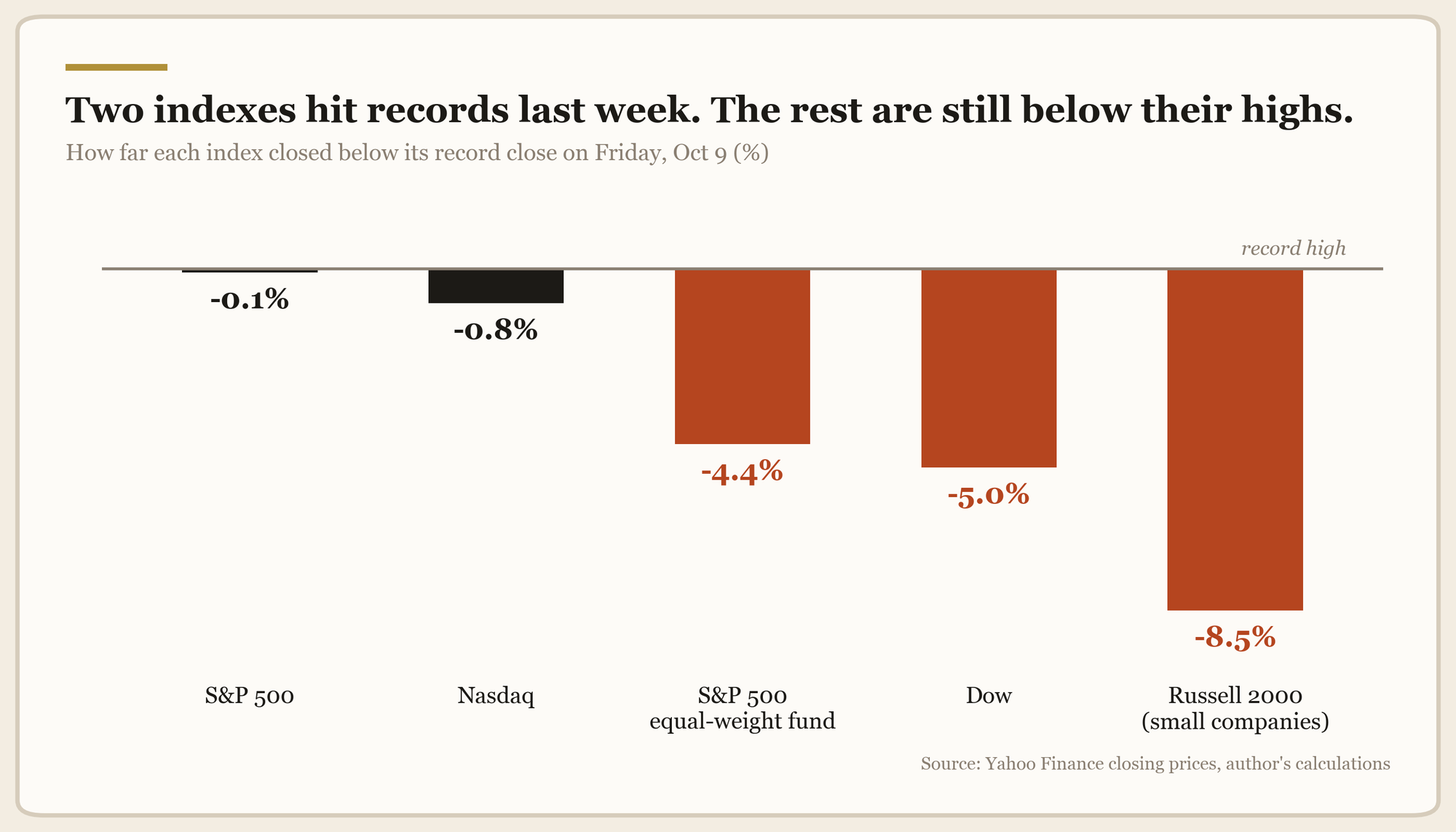
Here's the part that surprised me. The Dow Jones Industrial Average is still about 5% below the record it set on August 5. The Russell 2000, an index of smaller companies, actually fell 0.9% last week while the S&P 500 rose 1.2%, and it's about 8.5% below its high from August 14. An S&P 500 fund that treats all 500 companies the same size, so that Nvidia counts as much as the smallest company, is about 4% below its own August high. All of those numbers are my own math from closing prices, but together they show that a "record high" doesn't mean the typical stock is at a record. The live blog from Yahoo Finance also pointed out that only about 25% of S&P 500 stocks were trading above their 50-day moving averages on Tuesday. A 50-day moving average is just a stock's average price over the past 50 trading days.
The Pressure Still Hasn't Gone Away
Bond yields and oil are still weighing on the market. The 10-year Treasury yield closed at 5.31% on Monday, its highest close since 2002, and the average 30-year mortgage rate hit 7.4% on October 8. Delta Air Lines missed earnings estimates and cut its profit outlook because its fuel bill was up 62% from a year earlier. Regular people also seem less cheerful than investors, since the University of Michigan's preliminary October reading of consumer sentiment fell to 46.3, its lowest level since May.
The Bottom Line
Stocks did hit records last week, and AI and chip companies did most of the work. But the Dow, small companies, and the average stock are all still well below their August highs. The indexes may be at record highs, but that doesn't mean the average stock is. The next question is whether the rest of the market can catch up.


Discussion
Comments
Loading…
Leave a comment
Be the first to share your thoughts.